JAMAICA
|
Oliver Cromwell, Lord Protector of England in sixteen hundred and something, decided that England should colonize lands in the west Indies. He sent Admiral Penn, father of Willian Penn who got credit for Pennsylvania in USA, with warships to carry out his orders. Penn was accepting volunteers from Ireland, Scotland, and Wales or any other able bodied fellows up for a fight. Spain was the country with most land in the Caribbean so go knock them off. Cromwell couldn't fathom Spain's hoard of gold and wanted to steal a share for the Commonwealth. The Admiral had a large fleet and attempted to invade and capture several ports in the Greater Antilles. Jamaica appeared to be poorly defended so it was into Port Royale, they sailed. Spanish settlers took their wealth and went to the northern side of the island and even on to Cuba - the spoil sports. The British didn't find much gold or silver and the King forgot to send remuneration or even supplies for poor old Penn so the soldiers went on their own. They persevered by hunting, bartering and stealing to find a better life - you know - went independent. Some joined in the wild life in the pirate haven of Port Royale, which all ended in 1692 because a humdinger of an earthquake moved the entire town and thousands of swashbucklers below the water level. Nevertheless a government was set up in Spanish Town and the Island of Jamaica was in business. Fifteen parishes were established with assemblies that sent representatives to Parliment. Englishmen they were and you know how they make up their own minds and also pass their own rules.There was lots of fertile land but awfully difficult to work in the hot humid climate so go find somebody who could. Money talks. Dutch and Portuguese obliged with shiploads of black folks from Africa. With all that help the English set about growing great crops, mostly sugar on which fortunes were built by absentee owners living in splendor in London and thereabouts. In and around spats with France, Spain, Netherlands and history tells us who else, England prospered - really got filthy rich - with the sugar trade for over fifty years. Well what goes around comes around or the pendulum swings... And wouldn't you know? The world got wise and decided that those black people inslaved were human. My heavens ! Blacks could no longer be beaten and abused into doing work they did not want to do. So of all things - slavers were put out of business. Wow! Major realignment here. Sugar and other crops that needed strong backs and steady workers (which those white folks were not) were, sort of, not profitable any more. There were other reasons, too, because folks are always inventing machines and discovering better ways to grow sugar as well as finding other plants from which to get the sweet stuff. Blacks freed from slavery had no means to get back to Africa although they thought seriously of it. Meanwhile they had to eat. Plenty of fruit hung on the trees to hold them over until they cleared land to grow their own. After all they had been forced to grow food for their former masters and they had a bunch of their own choices. Golly, what better to do than stake out a piece of land, register it with a notary and keep their own families healthy. And then they formed assemblies and crafted laws in their own interests. Jamaican people, displaced blacks and diluted blacks, began to govern themselves. Jamaica gained independence from Britain in 1965. Blacks have shown their intelligence, creativity, and perseverance, which we know they had all along, and govern well. The Jamaican people rely a lot on tourist dollars so get yourself a good environmentally aware birder and naturalist like Mark Smith from Portland, Oregon, USA, and spend time in the lush warm country of Jamaica. |
|
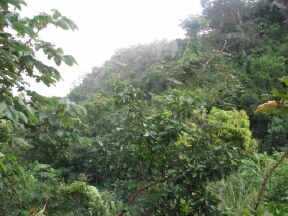
Jamaica is lush with various green foliage so intent in reaching for the sunlight you cannot see the limestone hills that support it. Thrust up millions of years ago the ocean floor is still being scraped off in the subduction of the caribbean plate and raising the mountains inland. |
|
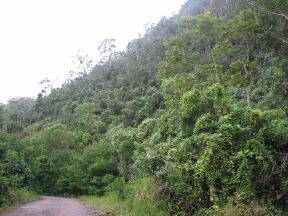
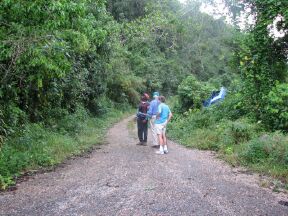
Highways were not the wide tarmac roads of my Washington state in the USA. We were happy to have a few hundred feet free of flooded potholes. |
|
Very few of the plants along the coast are native to Jamaica. Botany was studied and plants exchanged around the world for centuries. We looked for native trees and bushes because that is where we could find the native species of the birds of Jamaica. We found many migrants from the United States among the bushes, often hearing them before we could see them. |
|
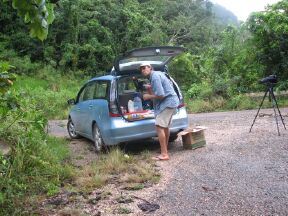
Stopping for a breakfast along the birding trail, Mark Smith laid out a veritable feast on the tailgate of the van. Still on the lookout for birds, we saw many warblers who were on their annual trip to Jamaica. |
|
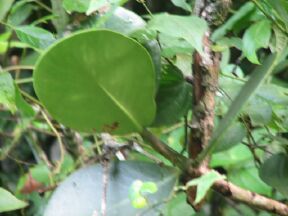
To get their share of the sun plants developed large leaves and they were thick to hold water against a drought in the hot sun. |
|
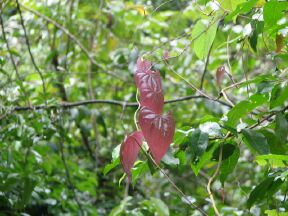
Contrasting colors and unusual alignment demanded a photograph. |
|
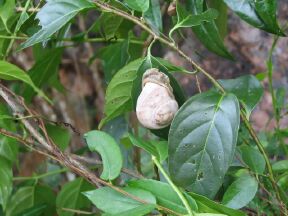
This snail shell is almost two inches long and no doubt the living animal would be a tasty morsel if I should indulge in escargo for dinner. I did not, however, chosing instead crab and lobster when dining along the coast. |
|
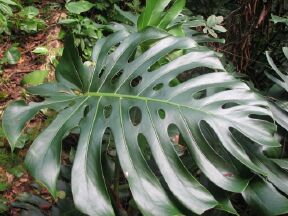
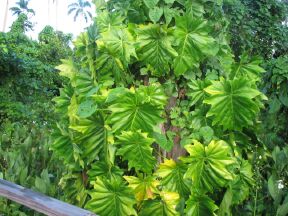
I found this philodendron to be really designed with the holes in the leaf that at first glance appeared to be eaten by an unseen snail. At thirty six inches, this leaf on its own stem would not fit into my living room. How about yours? |
|
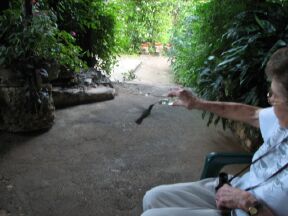
Africans call humming birds Sunbirds. In Jamaica they are called Hummers. Many were happy in this special garden and took to bottle feeding which delighted us. When not feeding, they zipped around so quickly as to defy identification so the feeder allowed a photo opportunity. |
|
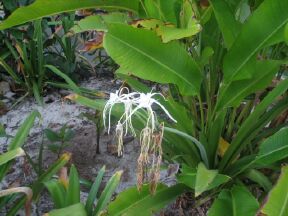
The spider lily is a unique blossom although not the most unusual to be found among the plants. |
|
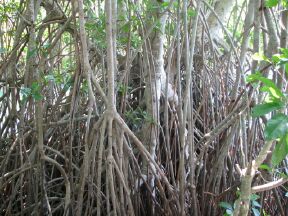
Cyprus trees grew in the water in Aligator Pond where manatees are raised and nutured and studied in the hope of preventing extinction of the species. |
|
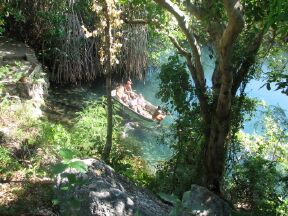
I walked up to the museum forty feet above the landing where the cyprus tree stood "knee" deep in Aligator Pond water. From the exhibition kiosk I could see some foreign visitors getting into a boat for a ride up river and a better view of the manatees. |
|
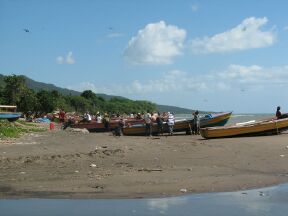
At treasure beach fishing boats came in to unload the catch they went many miles out for early yesterday morning. Here helpers are waiting for the next group to arrive. They will help unload the fish and wait for their women to weight, then clean and sell. Some are buyers for nearby restaurants, some just buy a couple for tonight's dinner. Many folks are too poor to have refrigeration. |
|
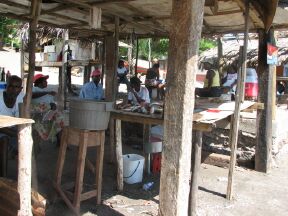
Women are the workers who weigh the fish, clean it if the buyers desire, and sell to those who get there first for their choice.They allowed no photos of the weighing and cleaning operations. |
|
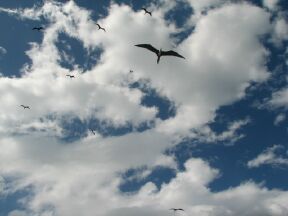
The Frigate birds sailed aloft waiting for the cleaning scraps from fish and prawns to be thrown into the surf. If they can't pick up scraps for themselves, they steal it from any other bird nearby. They take their nick name 'man o war' seriously. |
|
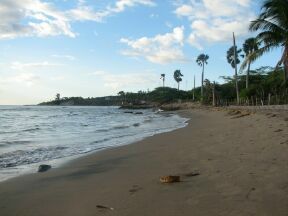
At our private hotel I could sit on the white sand and watch the surf come in. Sand piled up more than eight inches on the lawn than when I was here three years ago. Wading into the water was no fun then. There was no sandy beach just rocky bottom. |
|
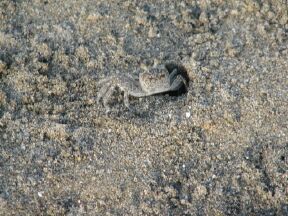
The edible part of this crab was served in the thorax shell - not this exact animal but one of the species - very deliciously in a spicey sauce. |
|
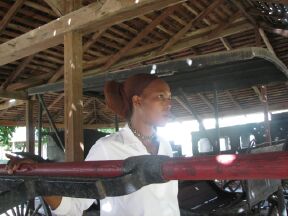
Our Rastifarian guide at the museum in Spanish town explained that women of her sect must cover their hair when out in public, therefore we could not view her dredlocks. She is explaining the pumping operation of an old British fire water truck. The windowed carriage in the middle background is a hearse dating back to the late 1700's. |
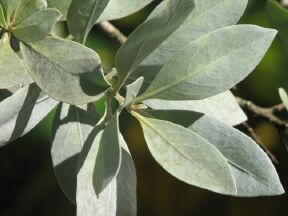 |
Plants are grown for their appearance but people have a closer affinity for them than mere viewing. They are early life on earth and we couldn't have developed until the largest ones filled the atmosphere with oxygen. It is a wonderful arrangement because we need plants to take up the carbon dioxide our lungs expel. |
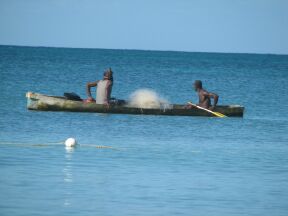 |
Just at daybreak, fishermen were heading out beyond the reef to set their nets for the days catch. Treasure beach or the Nigil area is used by tourists and wealthy landowners for vacation homes. Glass bottom boats were used for tourists to view the reef animal and plant life as well as base for snorkelers. This immediate area was closed to fishing. |
 |
We visited a nature preserve that had a raised board walk on which we walked into the wetlands area. In the far upper left corner you can see trees covered with vines that are working valiantly to snuff out the host plants. Not noxious in the sense of poisonous but a lethal danger to nativer species, nevertheless. |
Copyright 2005
SalmonRiverPublishing